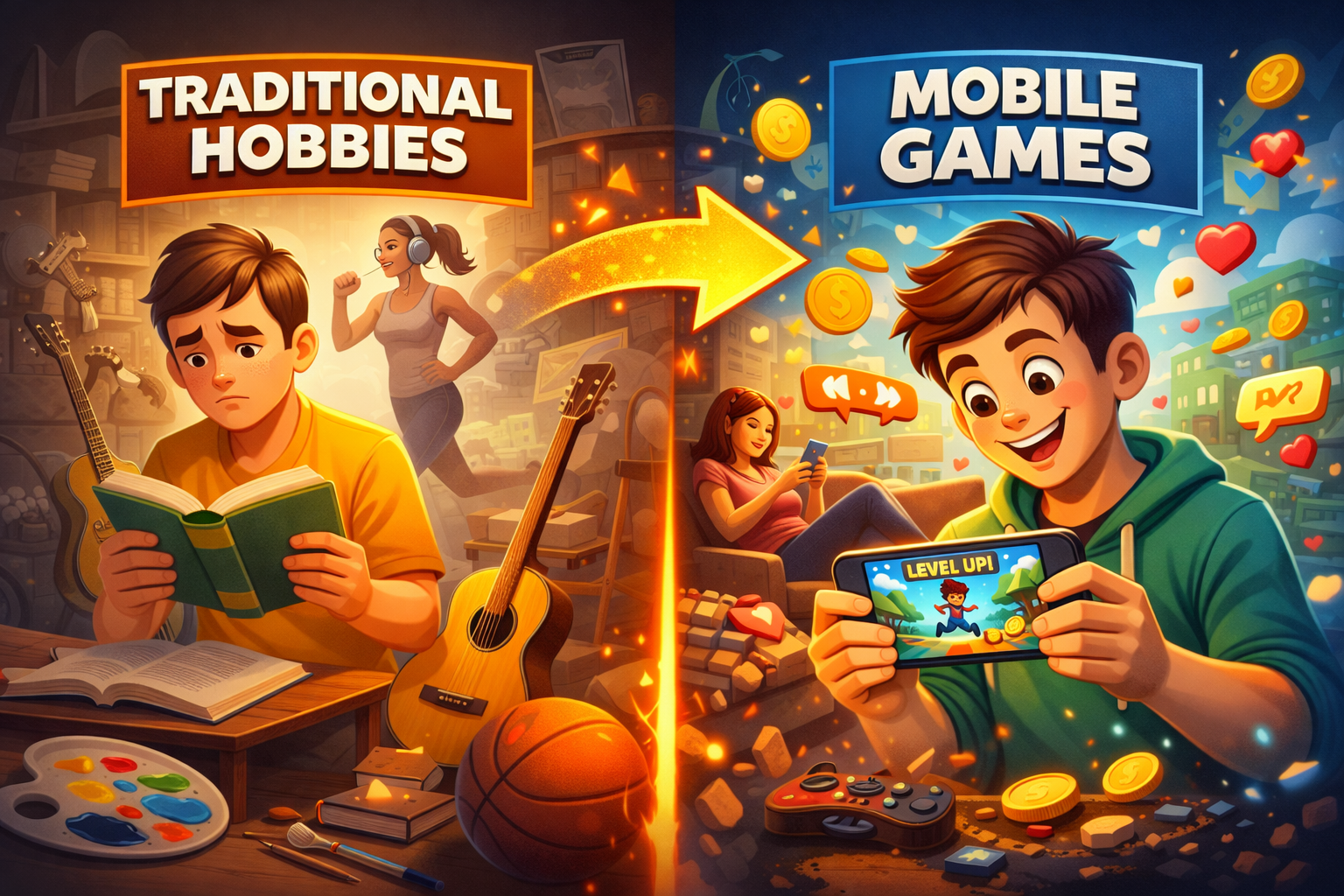
Not long ago, people spent their free time reading books, playing outdoor sports, learning musical instruments, or socializing face to face. Today, a simple glance around any public place tells a different story — most people are on their phones, playing games.
Mobile games have quietly become one of the most dominant forms of entertainment, slowly replacing traditional hobbies across all age groups. This shift didn’t happen overnight, but its impact is now impossible to ignore.
So why are mobile games taking over activities that once defined leisure time? Let’s explore the reasons behind this global change.
⏳ 1. Mobile Games Fit Perfectly Into Busy Lives
Modern life is faster and more demanding than ever. People have less uninterrupted free time, and traditional hobbies often require:
-
Preparation
-
Dedicated time
-
Physical effort
-
Specific locations
Mobile games remove all these barriers.
You can play anytime:
-
During short breaks
-
While commuting
-
Before sleeping
-
While waiting
This convenience makes mobile games more compatible with modern lifestyles than hobbies like reading or sports.
https://play1.11winners.pro/how-mobile-games-are-replacing-traditional/
🧠 2. Instant Entertainment Beats Long-Term Effort
Traditional hobbies usually take time before they become enjoyable:
-
Reading requires focus
-
Sports need physical energy
-
Music needs practice
Mobile games offer instant fun.
With just one tap, players get:
-
Immediate action
-
Quick rewards
-
Fast progress
The brain naturally prefers activities that deliver fast dopamine, making mobile games more appealing than hobbies that reward patience.
📱 3. Smartphones Have Become the New Entertainment Hub
Smartphones now replace:
-
Books
-
Board games
-
Music players
-
TVs
Mobile game live inside a device people already carry everywhere. Unlike traditional hobbies that require extra tools or space, mobile gaming needs nothing extra.
This constant availability makes gaming the default choice whenever boredom strikes.
🎯 4. Mobile Games Feel Less Like “Work”
Many traditional hobbies start to feel like responsibilities:
-
“I should practice”
-
“I should read more”
-
“I should exercise”
Mobile games feel light, casual, and pressure-free. There are:
-
No schedules
-
No expectations
-
No performance anxiety
This relaxed nature makes mobile games emotionally easier to choose, especially after a tiring day.
https://www.mdpi.com/2227-9032/13/15/1805
🔁 5. Habit-Forming Design Keeps Players Engaged
Mobile games are designed using behavioural psychology:
-
Daily rewards
-
Streaks
-
Level progression
-
Notifications
These systems encourage players to return every day. Traditional hobbies rarely have such built-in reminders or rewards.
Over time, gaming becomes a daily habit, slowly replacing other activities.
👨👩👧 6. All Age Groups Are Playing
Traditional hobbies are often age-specific:
-
Sports for the young
-
Reading for adults
-
Crafts for seniors
Mobile games break this boundary.
Children, teens, adults, and even seniors all play mobile games. Simple mechanics and intuitive controls make them universally accessible.
This wide appeal accelerates their dominance over traditional hobbies.
🌍 7. Social Connection Has Gone Digital
Many hobbies were social by nature:
-
Playing sports together
-
Group reading
-
Family games
Mobile games now offer:
-
Online multiplayer
-
In-game chats
-
Global communities
For many players, these digital connections replace physical social activities. The sense of belonging keeps them engaged longer.
📉 8. Decline of Outdoor and Creative Activities
Studies and lifestyle observations show declining participation in:
-
Outdoor play
-
Reading for pleasure
-
Arts and crafts
Mobile game compete directly for time and attention. When free time is limited, people often choose the activity that offers maximum entertainment with minimum effort.
⚖️ Is This Change Entirely Negative?
Not completely.
✅ Positive Aspects:
-
Stress relief
-
Mental stimulation
-
Easy accessibility
-
Social connection
❌ Negative Aspects:
-
Reduced physical activity
-
Shortened attention spans
-
Less creative engagement
-
Increased screen dependence
The problem isn’t mobile games themselves — it’s imbalance.
🔮 The Future of Hobbies in a Mobile-First World
Traditional hobbies are not disappearing, but they are evolving.
We are seeing:
-
Reading apps replacing physical books
-
Fitness games replacing gym sessions
-
Digital art replacing traditional drawing
The future likely lies in hybrid hobbies, combining digital convenience with real-world benefits.
🧠 Final Thoughts
Mobile game didn’t replace traditional hobbies by force — they replaced them by fitting better into modern life. Convenience, instant rewards, habit-forming design, and universal accessibility have made them the go-to choice for entertainment.
The challenge ahead is not to eliminate mobile gaming, but to balance it with meaningful offline activities.
In a world driven by screens, the way we choose to spend our free time matters more than ever.